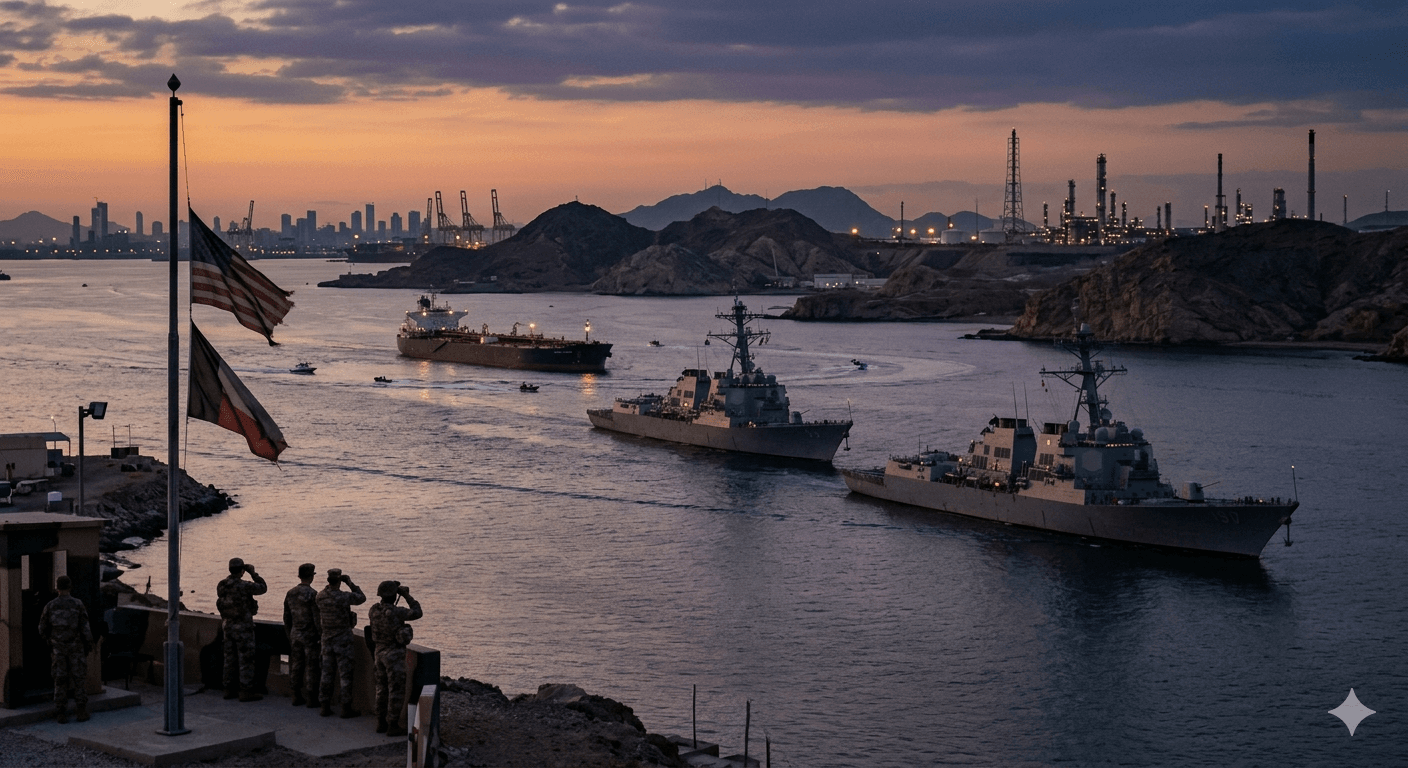

As of late April 2026, the situation remains a volatile deadlock. With the U.S. Navy maintaining a strangling blockade on Iranian ports and Tehran effectively sealing the Strait of Hormuz, the world watches as two of the planet’s most influential powers engage in a high-stakes game of chicken that neither side seems willing—or able—to exit.
The Catalyst: February’s Airstrikes and the Descent into War
While tensions have simmered since the collapse of previous diplomatic frameworks, the current conflict ignited in February 2026. A joint U.S.-Israeli military operation targeted key Iranian nuclear facilities and military infrastructure. The stated goal was to permanently disable Iran’s enrichment capabilities, which Washington claimed had reached “the point of no return.”
Iran responded not just with rhetoric, but with a multi-front military counter-offensive. Leveraging its influence over regional proxies and deploying its advanced drone and missile programs, Iran struck back at regional hubs, prompting the U.S. to deploy a massive naval presence. Today, three carrier strike groups—led by the USS George H.W. Bush, USS Gerald R. Ford, and USS Abraham Lincoln—patrol the waters, enforcing a “maximum pressure” blockade that has essentially severed Iran’s maritime trade.
The Diplomatic Deadlock in Islamabad
For a brief moment in mid-April, there was a flicker of hope. Pakistan, acting as a neutral mediator, organized a high-level summit in Islamabad. The goal was to bring U.S. and Iranian officials to the same table for the first time since the hostilities began. However, those hopes were dashed this past Saturday.
President Trump abruptly cancelled the planned trip of envoys Steve Witkoff and Jared Kushner to Pakistan. Simultaneously, Iranian Foreign Minister Abbas Araghchi departed the summit without ever meeting a U.S. representative. Araghchi’s parting statement was clear: “No meeting is planned.” Iran’s stance is firm—they will not negotiate while under the “gunpoint” of a naval blockade. Conversely, Washington’s demands have hardened into a “zero enrichment” policy, coupled with an absolute demand for the cessation of Iranian support for groups like Hezbollah and the Houthis.
“We are not seeking regime change, but we are seeking a total change in behavior,” a State Department spokesperson noted earlier this week. “The blockade remains until the enrichment stops.”
Economic Warfare: The Collapse of the Rial
While the physical war is fought with missiles and carriers, the economic war is being fought in the ledgers of global banks. The Iranian Rial (IRR) has experienced a catastrophic devaluation. The U.S. Treasury has labeled this the “grand culmination” of its economic strategy, aiming to dry up the resources Iran uses to fund its military and regional allies.
For the average Iranian citizen, the results are devastating. Hyperinflation has made basic goods inaccessible for many, leading to a humanitarian crisis that NGOs are struggling to address amidst the blockade. The U.S. maintains that the economic pain is a direct result of Tehran’s “malign activities,” while Tehran accuses Washington of “economic terrorism” aimed at the civilian population.
The Global Impact: Oil and Energy Security
The conflict is not contained within the borders of the Middle East. Because the Strait of Hormuz—a chokepoint for 20% of the world’s oil—is currently a “no-go zone,” global energy markets are in a state of panic. Brent crude prices have surged to over $105 per barrel, with analysts warning that a prolonged closure could see prices hit $150.
This spike has triggered inflationary pressures worldwide. From gas stations in the American Midwest to industrial hubs in East Asia, the “war tax” on energy is being felt by everyone. European nations, already weary of energy instability, are caught in a difficult position, balancing their security alliances with the U.S. against the desperate need for market stability.
Military Posture and the Risk of Miscalculation
The concentration of military hardware in the Persian Gulf and Gulf of Oman is unprecedented. With three U.S. aircraft carriers in close proximity to Iranian coastal defenses, the risk of a “spark”—an accidental collision, a misunderstood radar signal, or a rogue drone strike—leading to a catastrophic escalation is higher than ever.
Military analysts suggest that Iran is relying on “asymmetric” tactics, using swarms of fast-attack boats and sophisticated sea mines to counter the U.S. Navy’s traditional dominance. The blockade has successfully halted most Iranian oil exports, but it has also backed a regional power into a corner, and a cornered adversary is often the most dangerous.
The Path Forward: Is There an Exit Ramp?
As of late April 2026, the path to peace is obscured by smoke and mutual distrust. For a breakthrough to occur, several things would likely need to happen:
- A “Freeze-for-Freeze” Agreement: A temporary lifting of the naval blockade in exchange for a documented halt in high-level uranium enrichment.
- Third-Party Guarantees: Involvement from nations like China or Oman to provide a “face-saving” mechanism for both sides to return to talks.
- Humanitarian Corridors: Allowing medical and food aid into Iran to de-escalate the civilian crisis while political negotiations continue.
However, with both domestic political environments in Washington and Tehran favoring a “tough” stance, the incentive to compromise is low. President Trump’s administration sees the current pressure as the only way to force a total capitulation, while Iran’s leadership views any concession under blockade as a threat to their national sovereignty.
Conclusion
The U.S.-Iran conflict of 2026 is more than a regional spat; it is a stress test for the modern international order. It challenges the limits of economic sanctions, the efficacy of naval power in the 21st century, and the world’s ability to prevent a regional war from becoming a global catastrophe. As we move into May, the world remains on edge, hoping that diplomacy can find a way through the blockade before the next missile is fired.
Stay tuned for further updates on the Middle East crisis and real-time analysis of global energy markets.





Leave a Reply