
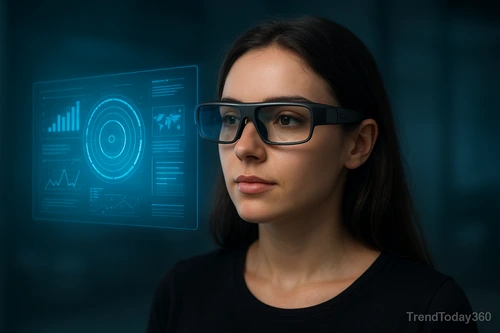

The relentless march of artificial intelligence continues to reshape industries, moving far beyond the confines of our smartphones and computers. Today, AI is seamlessly integrating into our daily lives through devices we once considered purely functional or fashionable – watches, home appliances, and, perhaps most strikingly, sunglasses. This isn’t just about adding a smart feature; it’s about fundamentally altering how we interact with information, capture memories, and perceive the world around us. The smart AI glasses revolution is here, and it’s set to redefine the very fabric of the gadget industry.
Leading technology companies are in a fierce race to innovate, pushing the boundaries of what eyewear can achieve. This intense competition is driving rapid advancements, bringing forth a new generation of smart glasses that are as stylish as they are intelligent. These devices aren’t just an accessory; they are a gateway to an augmented reality, a constant companion providing information, connection, and convenience right before our eyes.
Pioneers of the Pinhole Revolution: Leading AI Glasses
Meta AI Glasses (Ray-Ban Meta Smart Glasses)
In a groundbreaking collaboration, Meta partnered with eyewear giant Ray-Ban to introduce its second generation of smart AI glasses. These devices represent a significant leap in wearable technology, seamlessly blending iconic style with cutting-edge AI capabilities. Far more than just glorified cameras, the Meta AI glasses offer a suite of features that enhance daily life. Users can capture high-resolution photos and 3K video, complete with immersive audio, preserving moments as they happen. The integrated Meta AI assistant provides hands-free control, answering questions, offering real-time information, and even performing visual analysis of what the user is seeing. This blend of seamless capture, intelligent assistance, and classic design makes them a compelling choice for those looking to effortlessly integrate AI into their social and personal lives.
Halliday: The World’s First Proactive AI Glasses
Halliday glasses are pushing the envelope with their focus on “proactive AI” and an “invisible display.” These glasses aim to deliver real-time updates and essential information without the user ever needing to consciously “look” at a screen. Imagine receiving subtle, crucial notifications or navigation cues directly within your field of vision, enhancing your awareness without diverting your attention. What makes Halliday particularly attractive to tech enthusiasts is its lightweight, retro-styled design, challenging the notion that smart tech must look futuristic and bulky. This blend of subtle intelligence and appealing aesthetics positions Halliday as a truly revolutionary device for seamless, non-intrusive information delivery.
Amazon Echo Frames (Gen 3)
Amazon has firmly established its presence in the smart eyewear market with its Echo Frames. Building on the success of previous iterations, the third generation focuses on integrating the popular Alexa voice assistant into a discreet and comfortable form factor. These glasses provide hands-free access to Alexa for a multitude of tasks – making calls, playing music, setting reminders, and accessing a vast array of information, all through open-ear audio that keeps the user connected to their surroundings. With various frame styles, including options for prescription, blue light filtering, and sunglasses, Echo Frames offer a practical and familiar entry point into the world of AI-powered eyewear for Amazon’s extensive user base.
Solos AirGo 3
Designed with both audio quality and advanced AI in mind, the Solos AirGo 3 smart glasses stand out for their robust communication features and integration with powerful AI models. Utilizing SolosChat, powered by advanced AI like OpenAI’s ChatGPT, these glasses can handle complex queries, engage in detailed conversations, and provide real-time language translation. This makes them invaluable for professionals, travelers, and anyone needing sophisticated hands-free assistance. Coupled with premium open-ear audio, the AirGo 3 offers a high-fidelity sound experience for music and calls, all within a comfortable and durable design.
VITURE Luma Pro
While many smart glasses focus on audio or subtle displays, the VITURE Luma Pro plunges into the realm of augmented reality (AR) and extended reality (XR) with a full, immersive virtual screen experience. These glasses project a massive, high-quality virtual display directly into the user’s field of view, effectively creating a portable, private cinema or a multi-monitor workstation. With features like myopia adjustment and a focus on media consumption and productivity, the Luma Pro demonstrates how AI is enabling us to carry vast digital workspaces and entertainment hubs in our pockets, transforming any location into an office or entertainment lounge.
How These Technologies Revolutionize the Tech Industry
The emergence of AI-powered smart glasses signifies a fundamental shift in the tech landscape, driving several key revolutions:
- Ubiquitous Computing and Contextual AI: Smart glasses are pushing computing beyond screens. They represent a significant step towards ubiquitous computing, where intelligence is seamlessly embedded into our environment and accessories. With cameras and sensors, these glasses can understand the user’s immediate context – recognizing faces, objects, landmarks, and even emotions – to deliver truly personalized and proactive information. This moves AI from merely answering questions to anticipating needs and providing relevant insights without explicit prompts.
- Hands-Free Interaction and Enhanced Productivity: The ability to access information, capture content, and communicate hands-free is a game-changer for productivity and convenience. From navigating unfamiliar cities to conducting remote work or simply documenting life’s moments, smart glasses free up our hands and attention, allowing for more natural and intuitive interaction with technology and the physical world.
- Blending Digital and Physical Realities: AR glasses, like the VITURE Luma Pro, are blurring the lines between the digital and physical realms. They enable us to overlay digital information, virtual objects, and massive screens onto our real-world view, opening up possibilities for immersive gaming, enhanced learning, remote assistance, and entirely new forms of entertainment and work. This is laying the groundwork for a truly mixed reality future.
- Democratization of Advanced AI: By embedding powerful AI assistants directly into accessible, everyday items, these glasses are democratizing advanced AI capabilities. Features that once required significant hardware or complex setups are now available at a glance or through a simple voice command, making sophisticated AI more approachable and integrated into daily routines for a broader audience.
- Shaping Future Human-Computer Interaction: The development of smart glasses is forcing a rethinking of human-computer interaction (HCI). Voice commands, subtle gestures, and gaze tracking are becoming primary modes of input, moving beyond touchscreens and keyboards. This exploration of intuitive, natural interfaces will undoubtedly influence the design of future technologies across the entire industry.
Final Thoughts
The AI glasses revolution is not merely about adding connectivity to eyewear; it’s about fundamentally rethinking how we perceive, interact with, and leverage information in our daily lives. From the discreet assistance of Meta AI glasses and Halliday’s proactive display to the immersive virtual screens of the VITURE Luma Pro, these devices are ushering in an era where technology is less about staring at a screen and more about experiencing an enhanced reality. As the competition heats up and innovations accelerate, smart AI glasses are poised to become an indispensable tool, seamlessly blending style, function, and intelligence into an entirely new personal computing paradigm. The future, quite literally, is looking brighter and smarter through these lenses.
FAQ
Q1: Are AI smart glasses just for recording videos and taking photos?
A1: While many smart glasses, like the Ray-Ban Meta glasses, excel at hands-free photo and video capture, their capabilities extend far beyond. They integrate AI assistants for real-time information, translation, communication, and in some cases, provide virtual displays for media and productivity.
Q2: Will AI glasses replace my smartphone?
A2: Not entirely, at least not yet. While AI glasses offer hands-free access to many smartphone features and introduce new functionalities, they generally work in conjunction with your smartphone or other devices. They act as a powerful extension, rather than a full replacement, enhancing convenience and offering new ways to interact with digital information.
Q3: Are these glasses comfortable and stylish enough for everyday wear?
A3: This is a major focus for manufacturers. Brands like Ray-Ban Meta and Halliday are specifically designing their smart glasses to be lightweight, comfortable, and visually indistinguishable from traditional, fashionable eyewear. This focus on aesthetics and wearability is crucial for widespread adoption.
Q4: What about privacy concerns with smart glasses that have cameras?
A4: Privacy is a significant consideration. Companies are addressing this through features like clear indicator lights when recording, and by emphasizing user control over data. However, as with any device that can capture visual information, users should be mindful of privacy implications and adhere to local laws and social norms.
Q5: What’s the difference between “AI glasses” and “AR glasses”?
A5: “AI glasses” is a broader term for any eyewear integrating artificial intelligence for various functions (e.g., voice assistance, contextual information, camera intelligence). “AR (Augmented Reality) glasses” specifically refer to glasses that overlay digital information and virtual objects onto the real world, often requiring advanced AI to blend these realities seamlessly. Many AR glasses are also AI glasses, but not all AI glasses are necessarily full AR displays.
Updates by TrendToday360.





Leave a Reply