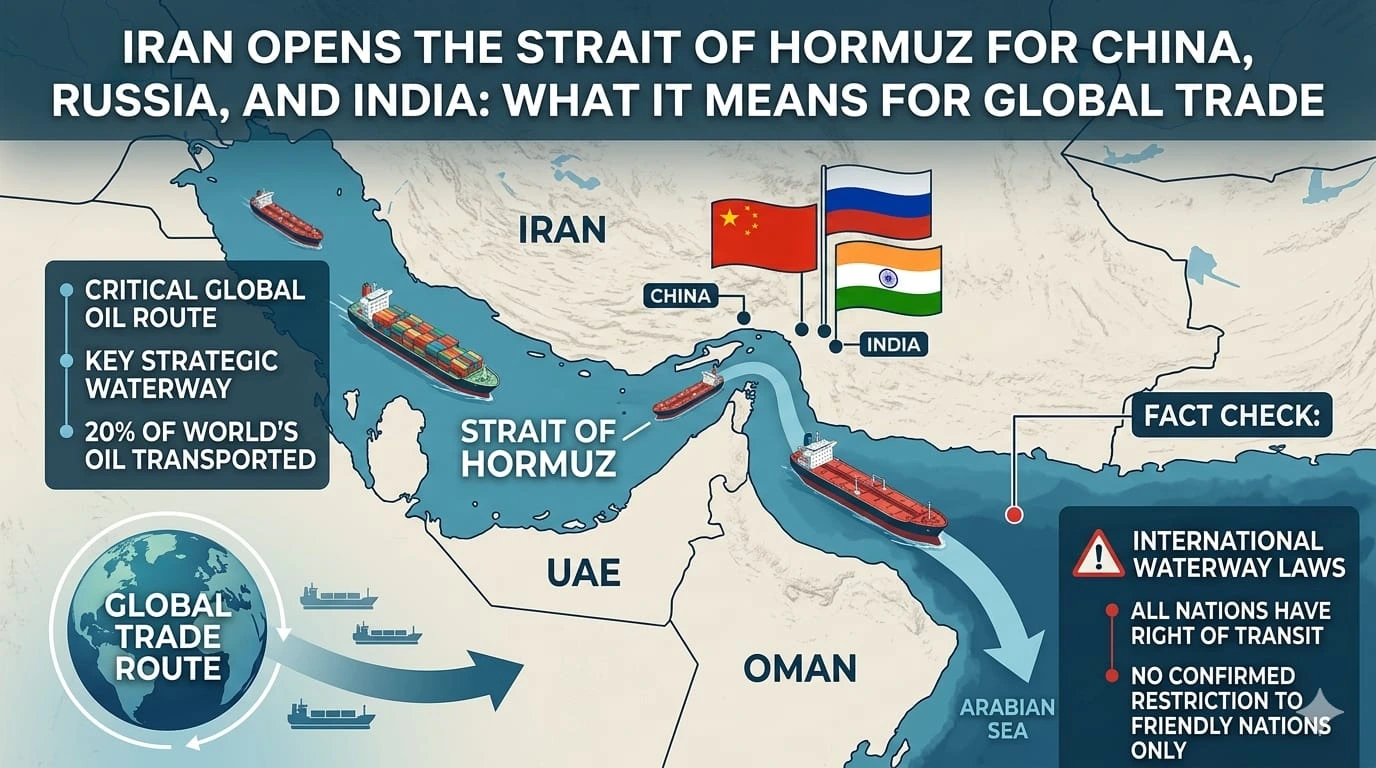

The Strait of Hormuz remains the world’s most critical maritime chokepoint, connecting the Persian Gulf to the Arabian Sea. With nearly 20% of the global oil supply flowing through this narrow channel, any shift in its accessibility sends shockwaves through global markets.
Iran’s “Friendly Nations” Policy: China, Russia, and India
In a major diplomatic move on March 25, 2026, Iranian Foreign Minister Seyed Abbas Araghchi officially announced that Iran is granting specific passage rights to “friendly nations.” This announcement follows weeks of maritime instability and a de facto blockade that saw shipping traffic drop to near-zero levels earlier this month.
According to official statements, the following countries have been granted cleared transit for commercial shipping:
- India: Cited for its deep bilateral ties and “significant help” during recent maritime incidents.
- China: Iran’s primary oil buyer and a key economic partner.
- Russia: A strategic geopolitical ally in the current regional landscape.
- Additional Partners: Including Iraq, Pakistan, and Sri Lanka.
The Legal Reality: International Waters vs. Sovereignty
While Tehran has frames this as an “opening” for friends, the move has sparked intense debate over International Maritime Law. The Gulf Cooperation Council (GCC) and Western allies argue that the Strait is an international waterway governed by UNCLOS (United Nations Convention on the Law of the Sea).
“Iran’s attempt to charge transit fees or discriminate between ‘hostile’ and ‘friendly’ vessels is a violation of the right of transit passage.” — GCC Secretariat Statement, March 2026.
Iran maintains that because the Strait lies within its territorial waters, it has the right to manage security, especially during a “state of belligerency.”
Donald Trump and the April 6 Deadline
The geopolitical subtext involves U.S. President Donald Trump, who recently extended a deadline to April 6, 2026, for Iran to fully reopen the Strait. While Trump has paused threatened strikes on Iranian energy plants, the situation remains a “tinderbox” for global trade.
What this means for the global economy:
- Energy Prices: Despite the “friendly” passage, insurance rates for the Strait have increased 4x to 6x, keeping oil prices volatile.
- Supply Chains: Diversifying routes around Africa continues to add weeks to shipping times for Western-linked vessels.
- Market Stability: Wall Street has recently seen significant losses tied to the uncertainty of these negotiations.
As the April 6 deadline approaches, the world watches to see if this “selective opening” will lead to a broader de-escalation or a total closure of the world’s most vital energy artery.
Stay tuned for more updates on Global Trade and Middle East Geopolitics.
Updates by TrendToday360



Leave a Reply