
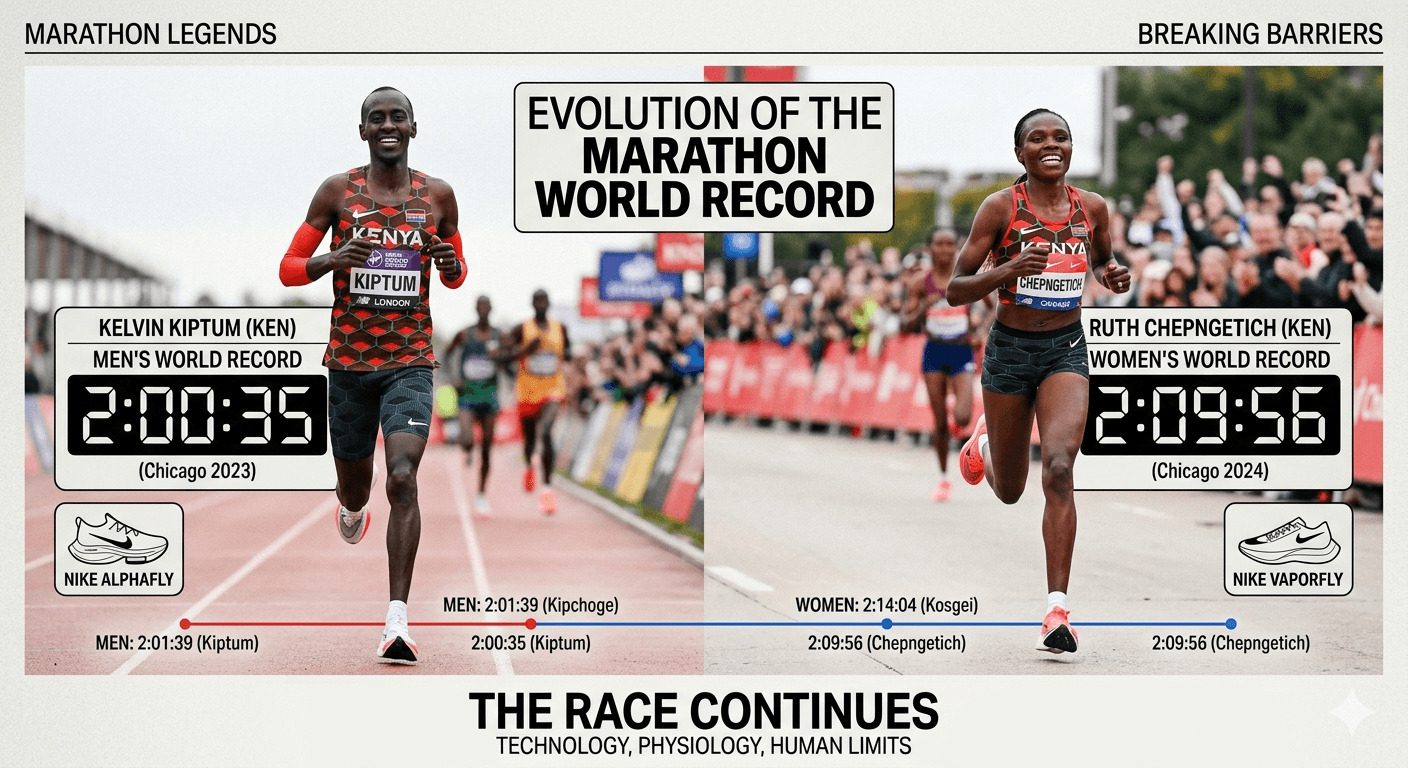

As of 2026, the marathon world records for both men and women have reached heights—and speeds—that were once considered physiologically impossible. This blog explores the current records, the legends who set them, and the controversy surrounding the tools that helped them get there.
The King of the Road: Kelvin Kiptum’s Legacy
The current official men’s world record stands at an astonishing 2:00:35. This mark was set by Kenya’s Kelvin Kiptum at the 2023 Chicago Marathon. To put this into perspective, Kiptum averaged roughly 4 minutes and 36 seconds per mile for 26.2 consecutive miles.
Kiptum’s rise was meteoric. Unlike many legends before him who spent years on the track, Kiptum transitioned almost immediately to the roads. His strategy was often described as “negative splitting”—running the second half of the race faster than the first. In Chicago, his performance shattered the previous record held by Eliud Kipchoge by 34 seconds.
Tragically, Kiptum passed away in early 2024, leaving the world to wonder: Could he have been the first to officially break the 2-hour barrier in a sanctioned race? His 2:00:35 remains the gold standard, a haunting reminder of a talent gone too soon.
Breaking the 2:10 Barrier: The Rise of Ruth Chepngetich
While the men were knocking on the door of the two-hour mark, the women’s record saw an equally seismic shift. In October 2024, Ruth Chepngetich stunned the world by running 2:09:56 at the Chicago Marathon. She became the first woman in history to break the 2:10 barrier, a feat many experts thought was decades away.
Chepngetich’s record is categorized as a “Mixed” world record because it was achieved in a race where male pacemakers were present. However, the performance was a masterclass in aggressive racing. She started at a blistering pace and held on, proving that the gap between men’s and women’s elite times is narrowing faster than ever before.
“I feel so proud of myself. This is my dream. I fought a lot thinking about the world record and I am fulfilled.” — Ruth Chepngetich after her 2:09:56 finish.
The Great “Sub-2” Debate: Kipchoge and the INEOS 1:59
No discussion of marathon records is complete without mentioning Eliud Kipchoge. While Kiptum holds the official record, Kipchoge holds the distinction of being the first human to run the distance in under two hours. In 2019, during the INEOS 1:59 Challenge in Vienna, he clocked 1:59:40.2.
Why isn’t it the official world record? World Athletics (the governing body) has strict criteria for records, including:
- Pacing: Kipchoge used teams of rotating pacemakers who hopped in and out of the race.
- Hydration: Drinks were delivered via bicycle rather than at fixed stations.
- Course: The course was optimized for aerodynamics and had no “open competition” elements.
Despite the “unofficial” tag, the event proved that the human body can sustain sub-2-hour pace, shifting the psychology of an entire generation of runners.
The “Super Shoe” Revolution
One cannot discuss these record-breaking times without mentioning what’s on the athletes’ feet. The introduction of carbon-plated “super shoes” (like the Nike Alphafly or Adidas Adizero Adios Pro) has fundamentally changed the sport. These shoes combine ultra-light, energy-returning foam with a rigid carbon fiber plate that acts as a lever.
Studies suggest these shoes can improve running economy by 4% or more. While some purists argue this is “technological doping,” others see it as the natural evolution of the sport. Regardless of the stance, the record books have been rewritten since 2017, coinciding almost perfectly with the rise of this footwear technology.
The Evolution of Training: Data and Recovery
Beyond shoes, the way elites train has evolved. The modern marathoner is a scientist as much as an athlete. Key factors include:
- High-Altitude Training: Most world-record holders live and train in the Rift Valley of Kenya or the highlands of Ethiopia, where the thin air increases red blood cell count.
- Continuous Glucose Monitoring (CGM): Athletes now monitor their blood sugar in real-time to optimize fueling, ensuring they never “hit the wall.”
- Lactate Threshold Testing: By taking finger-prick blood samples during workouts, coaches can ensure the athlete is training at the exact intensity required to maximize aerobic capacity without overtraining.
The Future: When Will 1:59 Become Official?
With the current record at 2:00:35, we are only 36 seconds away from an official sub-2-hour marathon. The “Big Six” World Marathon Majors—Tokyo, Boston, London, Berlin, Chicago, and New York City—continue to offer fast courses and deep prize purses that attract the world’s best.
Berlin remains the favorite for the next record attempt due to its flat profile and cool autumn weather, but Chicago has recently proven it can produce historic times. As training methods refine and shoe technology hits its peak, the question is no longer if the record will fall, but who will be the one to do it.
Conclusion
The marathon world record is more than just a number; it is a testament to the relentless human spirit. Whether it’s the raw power of Ruth Chepngetich or the tactical brilliance of the late Kelvin Kiptum, these athletes remind us that “No Human Is Limited.”
As we look toward the 2026 and 2027 seasons, the eyes of the running world remain fixed on the clock. Every second shaved off is a victory for the species.
Are you feeling inspired to hit the pavement? Whether you’re aiming for a world record or your first 5K, the journey starts with a single step. Would you like a customized 16-week marathon training plan or a breakdown of the best carbon-plated shoes currently on the market?




Leave a Reply