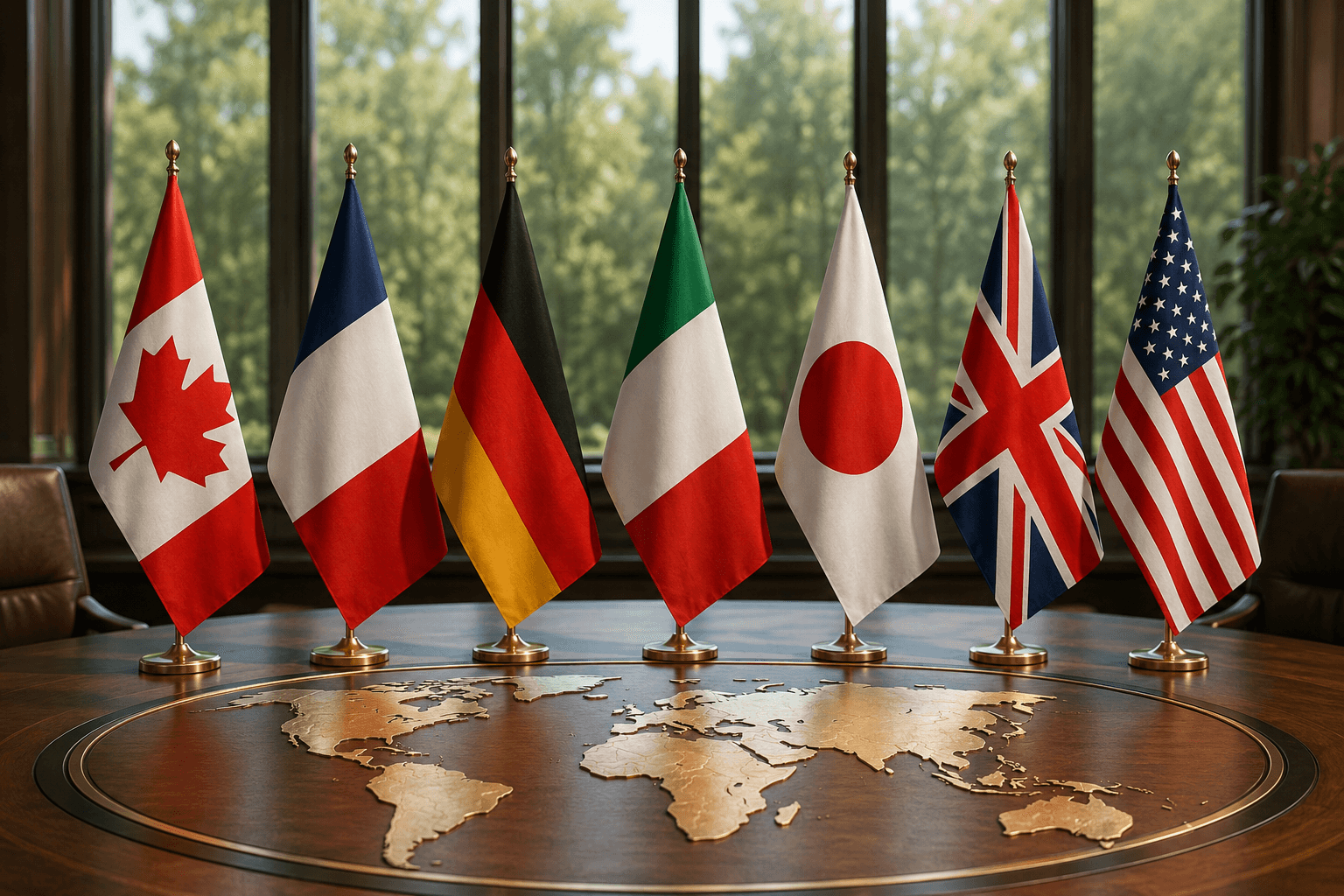

The Group of Seven, commonly known as the G7, is one of the world’s most influential international forums. It brings together seven of the world’s largest advanced economies to discuss global economic policies, international security, climate change, trade, technology, and geopolitical challenges.
Although the G7 is not a formal international organization with binding authority, its decisions and discussions often shape global policy and influence international cooperation. The group plays a significant role in addressing some of the most pressing issues facing the world today.
This article explores the history of the G7, its member countries, objectives, achievements, challenges, and its importance in the modern global economy.
What Is the G7?
The G7 is an informal grouping of seven major industrialized democracies. Leaders from member nations meet annually at a summit to discuss economic, political, and security issues affecting the world.
The forum also includes meetings among finance ministers, foreign ministers, central bank governors, and other government officials throughout the year.
The G7 was established to encourage cooperation among leading economies and coordinate responses to international crises.
History of the G7
The origins of the G7 date back to 1975 when leaders from six countries met in France to discuss economic challenges following the global oil crisis and economic recession.
The original group consisted of:
- France
- West Germany
- Italy
- Japan
- United Kingdom
- United States
Canada joined the following year, creating the Group of Seven or G7.
In 1998, Russia joined, forming the G8. However, Russia’s membership was suspended in 2014 following geopolitical tensions surrounding Crimea, and the group returned to the G7 format.
The Seven G7 Member Countries
United States
The United States is the world’s largest economy and a major force in international finance, technology, defense, and innovation. It plays a leading role in shaping G7 priorities and global policy discussions.
Canada
Canada contributes significantly through its strong economy, natural resources, stable democratic institutions, and commitment to international cooperation.
United Kingdom
The United Kingdom is a major global financial center and an important diplomatic and military power. It remains a key voice within the G7 framework.
France
France has been central to European and global diplomacy for decades. It actively promotes international cooperation on climate policy, security, and economic development.
Germany
Germany is Europe’s largest economy and a global leader in manufacturing, engineering, and exports. Its economic strength makes it a critical member of the G7.
Italy
Italy contributes through its industrial economy, cultural influence, and strategic position within Europe and the Mediterranean region.
Japan
Japan is one of the world’s leading economies and a global leader in technology, innovation, and industrial development. It plays a vital role in discussions concerning Asia-Pacific affairs.
The European Union’s Role
Although not counted as one of the seven member countries, the European Union participates in G7 meetings and discussions.
Representatives from the European Commission and the European Council attend summits and contribute to policy discussions on behalf of EU member states.
This involvement strengthens coordination between Europe and other major economies.
Main Objectives of the G7
The G7 focuses on addressing global challenges through cooperation and dialogue.
Its key objectives include:
- Promoting global economic stability
- Strengthening international security
- Supporting democratic values
- Addressing climate change
- Enhancing global health cooperation
- Encouraging sustainable development
- Managing emerging technologies and cybersecurity risks
These priorities evolve over time based on changing global conditions.
Economic Influence of the G7
The G7 countries collectively represent a significant portion of global economic output.
Despite the rise of emerging economies, the group continues to account for a substantial share of global GDP, international trade, and investment flows.
Because of their economic influence, G7 decisions often affect international financial markets and economic policies worldwide.
Annual G7 Summit
The annual G7 Summit is the most visible activity of the organization. Leaders meet to discuss major international issues and coordinate policy responses.
Each member country rotates as summit host, setting the agenda and organizing discussions.
The summit often results in joint statements outlining shared commitments and policy goals.
Climate Change and Environmental Policies
Climate change has become one of the G7’s most important priorities.
Member countries frequently discuss strategies to reduce greenhouse gas emissions, expand renewable energy, and support sustainable economic growth.
The G7 has increasingly emphasized environmental protection and climate resilience in recent years.
Global Security and Geopolitical Issues
The G7 also addresses international security concerns, including armed conflicts, terrorism, cyber threats, and geopolitical tensions.
Through coordinated diplomatic efforts, member countries seek to promote stability and uphold international law.
Security discussions often focus on both traditional and emerging threats.
Technology and Innovation
Rapid technological change has become a major topic within G7 discussions.
Leaders address issues such as artificial intelligence, digital infrastructure, data privacy, cybersecurity, and emerging technologies.
The goal is to maximize the benefits of innovation while minimizing potential risks.
Global Health Cooperation
The COVID-19 pandemic highlighted the importance of international health cooperation.
The G7 has worked to strengthen global health systems, improve pandemic preparedness, and support vaccine distribution initiatives.
Health security remains a major component of the group’s agenda.
Criticisms of the G7
Despite its influence, the G7 faces criticism from some observers.
Common criticisms include:
- Limited representation of developing nations
- Lack of legally binding authority
- Perceived focus on advanced economies
- Difficulty achieving consensus on complex issues
Critics argue that broader forums such as the G20 may better reflect the realities of the modern global economy.
G7 vs. G20
The G20 includes both advanced and emerging economies, representing a larger share of the world’s population and economic activity.
While the G20 focuses on broader global coordination, the G7 often serves as a forum for like-minded democratic nations to coordinate policies more closely.
Both groups play important but distinct roles in international governance.
Future Challenges for the G7
The G7 faces a rapidly changing world characterized by technological disruption, climate risks, geopolitical competition, and economic uncertainty.
Maintaining unity among members while addressing complex global issues will remain a significant challenge.
The group’s effectiveness will depend on its ability to adapt to evolving international realities.
Conclusion
The G7 remains one of the most influential forums for international cooperation among advanced democracies. Through discussions on economics, security, climate change, technology, and global health, the group continues to shape policies that affect billions of people worldwide.
Although it faces challenges and criticism, the G7 plays an important role in promoting dialogue and coordinating responses to global issues. As the international landscape evolves, the group’s ability to foster cooperation among major economies will remain critical to addressing the challenges of the 21st century.



Leave a Reply