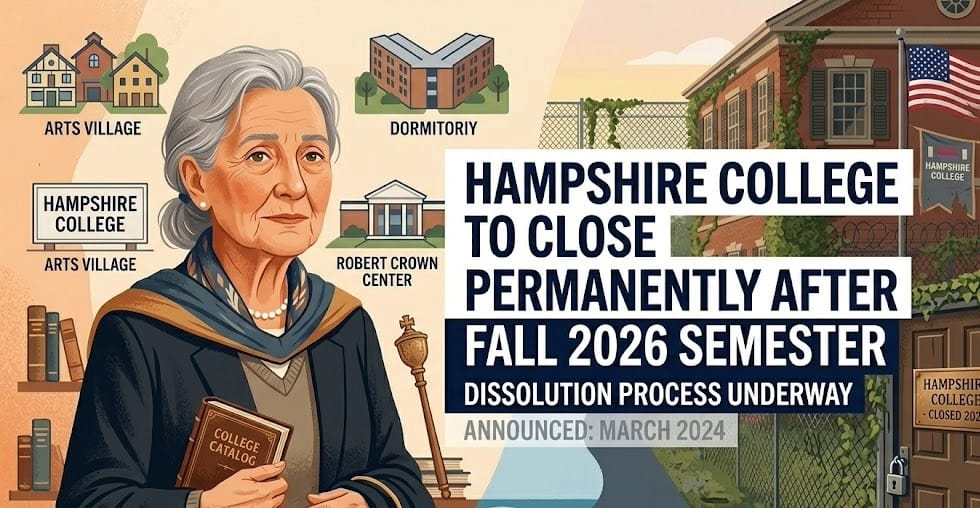

In a move that has shocked students, alumni, and educators across the United States, Hampshire College has announced that it will permanently close after the Fall 2026 semester. Known for its unconventional and progressive approach to higher education, the college’s closure marks the end of a unique academic experiment that lasted more than five decades.
The news has sparked emotional reactions and renewed debates about the sustainability of alternative education models in today’s rapidly changing academic landscape.
A Legacy of Innovation
Founded in 1970 in Amherst, Massachusetts, Hampshire College was never a typical institution. It was established as part of the Five College Consortium, alongside Amherst College, Smith College, Mount Holyoke College, and the University of Massachusetts Amherst.
From the beginning, Hampshire challenged traditional academic structures. Instead of grades, it used narrative evaluations. Instead of rigid majors, it encouraged students to design their own interdisciplinary fields of study.
This approach attracted students who sought creativity, independence, and intellectual freedom—qualities that defined Hampshire’s identity for decades.
Why Is Hampshire College Closing?
The decision to close did not come overnight. Like many small liberal arts colleges, Hampshire has faced ongoing financial challenges in recent years.
Key factors include:
- Declining enrollment: Fewer students enrolling each year reduced tuition revenue.
- Rising operational costs: Maintaining campus facilities and programs became increasingly expensive.
- Limited endowment: Compared to peer institutions, Hampshire had fewer financial reserves to fall back on.
- Changing student preferences: Many students now prioritize career-oriented programs and job security.
Despite attempts to restructure and secure funding, the college ultimately determined that closure was the most viable option.
Impact on Students
For current students, the announcement has created uncertainty and anxiety. The college has assured that all enrolled students will be able to complete their degrees, either at Hampshire before closure or through transfer arrangements with partner institutions.
However, the transition will not be easy. Students who chose Hampshire for its unique educational model may struggle to find equivalent programs elsewhere.
Many have expressed disappointment, not just at the disruption of their education, but at the loss of a community that valued individuality and creativity.
Faculty and Staff Face Uncertain Future
The closure also affects faculty and staff, many of whom have dedicated their careers to the institution. Job losses are inevitable, and while some may find positions at other colleges, the transition will be challenging.
Hampshire’s faculty were known for their mentorship-driven teaching style, often working closely with students on independent projects. Losing this environment represents a significant shift for both educators and learners.
The Broader Crisis in Higher Education
Hampshire College’s closure is part of a larger trend affecting small liberal arts colleges across the United States.
Many institutions are struggling with:
- Demographic shifts leading to fewer college-age students
- Increased competition from larger universities and online programs
- Rising student debt concerns
- Pressure to demonstrate clear career outcomes
These challenges have forced several colleges to merge, downsize, or shut down entirely in recent years.
A Unique Educational Philosophy
What set Hampshire apart was its commitment to student-driven learning. The college emphasized critical thinking, creativity, and real-world problem-solving over standardized testing and rigid curricula.
Students often worked on self-designed projects, collaborated across disciplines, and engaged in experiential learning opportunities.
This model was not for everyone, but for those who embraced it, Hampshire offered an education unlike any other.
Alumni Reactions and Support
Hampshire alumni, many of whom have gone on to successful careers in fields like arts, activism, science, and technology, have reacted with sadness and concern.
Some have called for renewed efforts to save the institution, while others are focused on preserving its legacy through scholarships, archives, and community initiatives.
The closure has also sparked discussions about the value of non-traditional education in a world increasingly focused on standardization and measurable outcomes.
What Happens to the Campus?
The future of Hampshire’s campus remains uncertain. Located in the scenic Pioneer Valley, the property could potentially be repurposed for educational, commercial, or community use.
Decisions about the campus will likely involve negotiations with stakeholders, including local authorities and partner institutions.
Lessons from Hampshire’s Closure
The story of Hampshire College offers important lessons for the future of higher education:
- Innovation must be balanced with financial sustainability
- Student demand is evolving rapidly
- Alternative education models face unique challenges
- Community and identity play a crucial role in institutional success
While Hampshire’s model inspired many, its closure highlights the difficulties of maintaining such a vision in today’s environment.
Conclusion
The closure of Hampshire College after Fall 2026 marks the end of a bold and innovative chapter in higher education. For over 50 years, the institution stood as a symbol of academic freedom and creativity.
As students, faculty, and alumni come to terms with this loss, the legacy of Hampshire will continue to influence conversations about how education can evolve.
In a world that often prioritizes standardization, Hampshire reminded us that learning can be deeply personal, creative, and transformative.
Its closure is not just the end of a college—it is the end of an idea that challenged the norms of education.





Leave a Reply