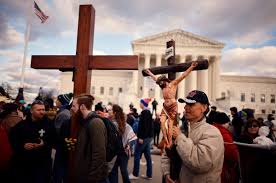

The Christian Right—often called the Religious Right—is arguably the most influential grassroots movement in modern American political history. What began as a loose collection of concerned believers in the late 1970s has evolved into a disciplined political machine that has reshaped the Republican Party and the United States judiciary.
Far from being a monolithic group, this movement is a coalition of evangelical Protestants, conservative Roman Catholics, and other traditionalists who believe public policy should reflect their interpretation of Christian moral teachings. To understand the United States today, one must understand how this movement rose to power and why it remains a central pillar of American conservatism.
The 1970s: The Spark of Mobilization
For decades, many evangelical Christians remained politically “quiet,” focusing on personal salvation rather than public policy. However, the social upheavals of the 1960s and 70s created a sense of moral crisis.
- Roe v. Wade (1973): While initially a Catholic-led issue, the legalization of abortion eventually became the primary rallying cry for the movement.
- IRS and Christian Schools: Some historians argue that the movement’s true “spark” was an IRS effort to revoke the tax-exempt status of private Christian schools that refused to desegregate, such as Bob Jones University.
- The Sexual Revolution: Rapid changes in gender roles and the rise of the feminist movement led many to believe that the “traditional nuclear family” was under attack.
Key Figures Who Built the Movement
The Christian Right did not emerge by accident; it was the work of savvy religious leaders and political strategists who saw the potential of the “born-again” voting bloc.
1. Jerry Falwell and the Moral Majority
In 1979, televangelist Jerry Falwell founded the Moral Majority. His mission was to register millions of conservative voters and convince them that voting was a religious duty. By 1980, Falwell was credited with helping deliver a landslide victory for Ronald Reagan.
2. Phyllis Schlafly: The Anti-ERA Crusader
A Catholic activist, Schlafly led the fight against the Equal Rights Amendment (ERA). She successfully framed feminism as a threat to the privileges of stay-at-home mothers and the sanctity of the home.
3. Pat Robertson and the Christian Coalition
After a failed presidential run in 1988, Robertson founded the Christian Coalition. Under the leadership of Ralph Reed, the group utilized a “stealth strategy” to win local school board and city council seats, effectively building power from the ground up.
Core Issues and the “Culture War”
The movement’s agenda has remained remarkably consistent over four decades, focusing on what it calls “traditional values”.
- Pro-Life Advocacy: Reversing Roe v. Wade was a multi-generational goal, finally achieved in 2022 with the Dobbs decision.
- Religious Liberty: In the 21st century, the focus has shifted toward protecting the “right of conscience”—ensuring that Christian business owners and organizations aren’t forced to support policies (like same-sex marriage or contraception mandates) that violate their beliefs.
- Education: The movement strongly advocates for school prayer, voucher programs that support private religious schools, and parental control over public school curricula.
The Shift to the Judiciary
One of the most significant strategic shifts occurred in the 1980s. Realizing that passing federal laws was difficult, the movement turned its focus to the U.S. Judiciary.
The goal became simple: appoint conservative judges who would interpret the Constitution through an “originalist” lens. This strategy solidified the alliance with the Republican Party, as voters were often told that even if they didn’t like a specific candidate, the “future of the Supreme Court” was at stake.
Modern Challenges: Christian Nationalism
In recent years, the movement has been linked to Christian Nationalism—the belief that the United States is a Christian nation and that the government should take active steps to maintain that identity.
Critics argue this ideology is undemocratic, as it potentially marginalizes non-Christian citizens. However, supporters view it as a necessary defense of America’s founding heritage and moral foundations.
The Future of the Movement
Is the Christian Right fading? While church attendance is declining overall, the movement’s political influence remains potent. Its ability to adapt to new digital media and its ironclad grip on the Republican base suggest it will remain a force for years to come.
As the nation becomes more secular, the movement is doubling down on “religious freedom” arguments to carve out legal protections for its institutions, ensuring that its voice—though perhaps no longer a “majority”—remains a powerful one.
Conclusion
The Christian Right is more than just a political group; it is a cultural phenomenon that has fundamentally changed how Americans think about the intersection of faith and the state. Whether you agree with their goals or not, their impact on the American story is undeniable.
Call to Action: What do you think is the biggest impact of the Religious Right on today’s politics? Share your thoughts in the comments below!




Leave a Reply