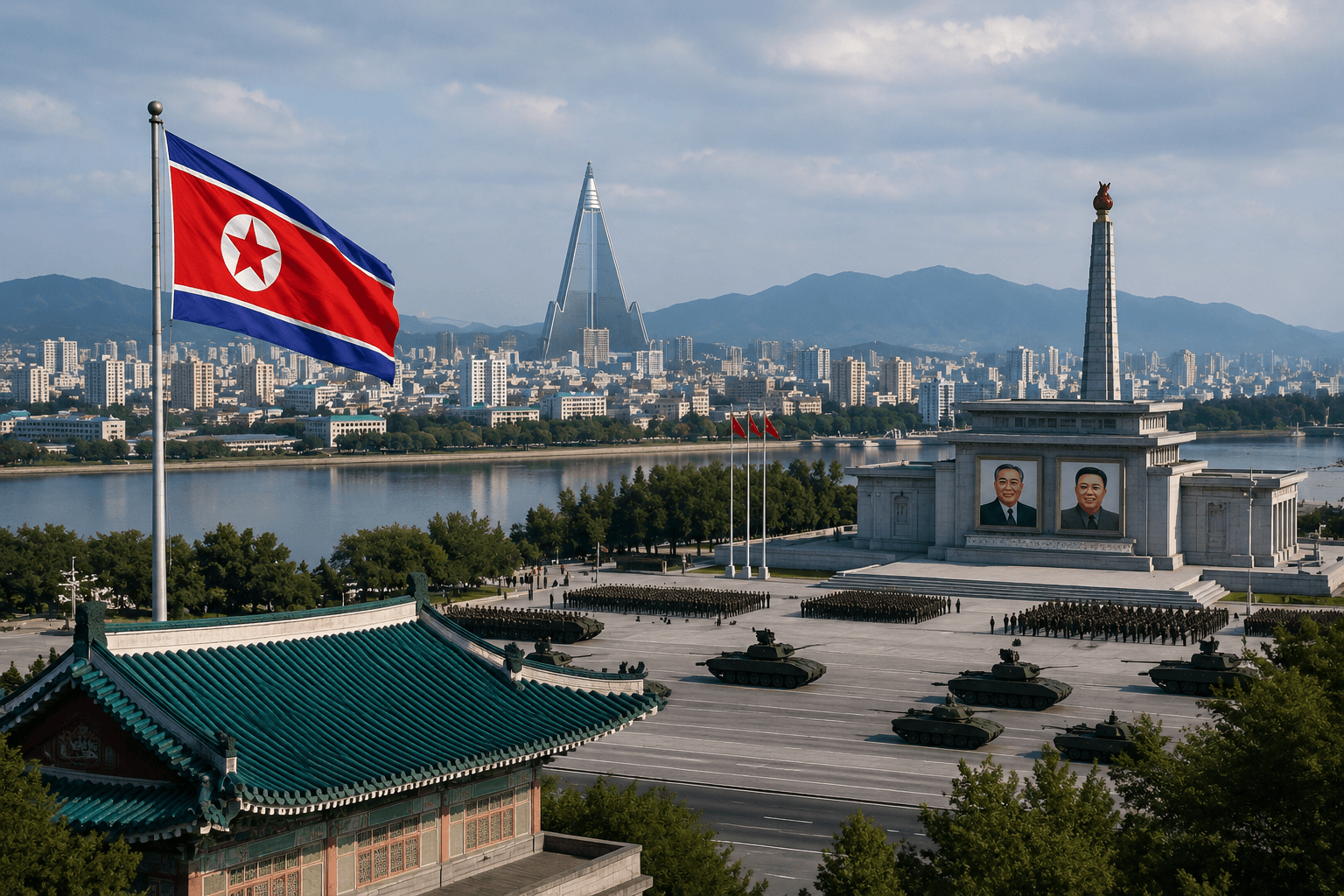

North Korea, officially known as the Democratic People’s Republic of Korea (DPRK), is one of the most isolated and heavily controlled countries in the world. Located on the northern part of the Korean Peninsula, it shares borders with China, Russia, and South Korea.
The country is known for its strict political system, limited external communication, and strong military focus. Because of restricted access and limited information, North Korea remains one of the most mysterious nations in global politics.
This article explores North Korea’s history, government structure, economy, military development, society, and its role in international relations.
Geography and Location
North Korea is located in East Asia, occupying the northern half of the Korean Peninsula. It has a coastline along the Sea of Japan (East Sea) and the Yellow Sea.
The country is mostly mountainous, with limited arable land concentrated in valleys and coastal plains.
Its strategic location between China, Russia, and South Korea makes it geopolitically significant in regional security discussions.
Historical Background
Korea was unified for centuries under various dynasties before being annexed by Japan in 1910. After Japan’s defeat in World War II, the Korean Peninsula was divided along the 38th parallel.
The northern region came under Soviet influence, while the south was influenced by the United States, leading to the formation of two separate governments.
In 1948, North Korea was officially established under Kim Il-sung, marking the beginning of a socialist state structure.
Korean War (1950–1953)
The Korean War began when North Korean forces invaded South Korea in 1950. The conflict involved major international powers, including the United States, China, and the United Nations forces.
The war ended in 1953 with an armistice agreement, not a peace treaty, leaving the Korean Peninsula technically still in a state of war.
The Demilitarized Zone (DMZ) was created as a buffer between North and South Korea and remains one of the most heavily guarded borders in the world.
Government and Political System
North Korea is a single-party state governed by the Workers’ Party of Korea. The country follows a centralized political ideology known as Juche, which emphasizes self-reliance.
Power is concentrated in the leadership of the Kim family, which has ruled the country since its founding.
The political system controls most aspects of life, including media, education, and economic activity.
Leadership Structure
The leadership of North Korea has passed through three generations:
- Kim Il-sung – Founding leader of North Korea
- Kim Jong-il – Son of Kim Il-sung, expanded military-first policies
- Kim Jong-un – Current leader, focusing on nuclear development and international negotiations
This hereditary leadership structure is unique among modern socialist states.
Military and Nuclear Development
North Korea places strong emphasis on military strength. The country maintains one of the largest standing armies in the world relative to population size.
It has also developed nuclear weapons and ballistic missile technology, which has led to international sanctions and diplomatic tensions.
Nuclear development is a central issue in North Korea’s foreign relations, especially with the United States, South Korea, and Japan.
Economy of North Korea
North Korea has a centrally planned economy controlled by the state. Most industries, agriculture, and services are state-owned.
The economy faces significant challenges, including limited trade, sanctions, and resource constraints.
China is North Korea’s largest trading partner and plays a key role in its economic stability.
Agriculture and Resources
Agriculture in North Korea is limited by geography and climate. The country experiences food production challenges due to mountainous terrain and periodic natural disasters.
Despite this, agriculture remains a critical sector, with rice, corn, and potatoes being major crops.
The country also has mineral resources such as coal, iron ore, and magnesite.
Daily Life in North Korea
Life in North Korea is highly structured and influenced by government policies. Citizens follow strict regulations regarding work, education, and social behavior.
Access to foreign media and internet is extremely limited, with most communication controlled by the state.
Housing, employment, and education are typically assigned by the government.
Education and Propaganda
Education in North Korea focuses heavily on ideology, national history, and loyalty to the state.
Students are taught from an early age about the leadership and the importance of national self-reliance.
Propaganda plays a significant role in shaping public perception and maintaining political stability.
Human Rights Concerns
North Korea has faced criticism from international organizations regarding human rights conditions.
Concerns include restrictions on freedom of speech, movement, and access to information.
Reports from defectors and human rights groups describe strict surveillance and limited personal freedoms.
Foreign Relations
North Korea’s foreign relations are shaped by its nuclear program and political ideology.
It maintains close ties with China and has engaged in diplomatic talks with countries such as the United States and South Korea at various times.
However, relations remain tense due to sanctions and security concerns.
Sanctions and International Pressure
The United Nations and several countries have imposed economic sanctions on North Korea due to its nuclear weapons program.
These sanctions affect trade, finance, and access to international markets.
North Korea argues that sanctions are a barrier to development and national sovereignty.
Technology and Development
Despite restrictions, North Korea has made limited progress in technology, particularly in military and communication systems.
The country operates its own controlled intranet instead of global internet access.
Technological development is heavily focused on state priorities, especially defense.
Culture and Society
North Korean culture is influenced by traditional Korean customs combined with socialist ideology.
Music, dance, and art are often used to promote national pride and political messaging.
Public performances and national celebrations play an important role in cultural life.
Media and Information Control
All media in North Korea is state-controlled, including television, radio, and newspapers.
Information from outside the country is heavily restricted.
This control system is designed to maintain political stability and ideological unity.
Future Outlook
The future of North Korea depends on diplomatic relations, economic reforms, and geopolitical developments.
Possible scenarios include continued isolation, gradual economic opening, or negotiated agreements on nuclear disarmament.
However, significant change would require major political and international shifts.
Conclusion
North Korea remains one of the most isolated and complex countries in the world. Its unique political system, military focus, and restricted society make it a central topic in global geopolitics.
While challenges remain in terms of diplomacy and economic development, North Korea continues to play an important role in regional security discussions.
Understanding the country requires careful analysis of its history, leadership, and international relations.




Leave a Reply