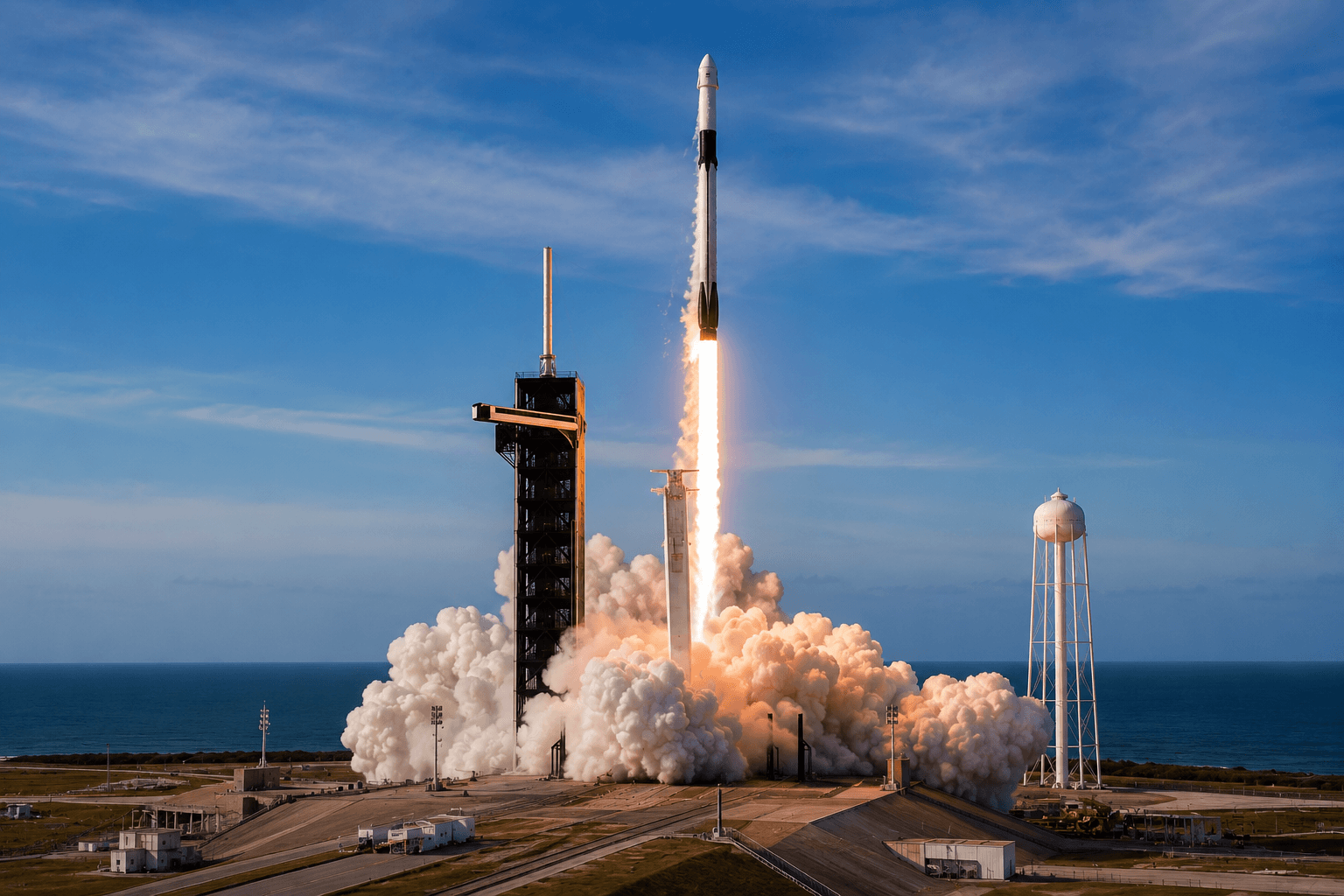

SpaceX, officially known as Space Exploration Technologies Corp., has transformed modern space travel with its innovative rocket technology, reusable launch systems, and ambitious missions to orbit, the International Space Station, and beyond.
Founded by Elon Musk in 2002, SpaceX aims to reduce space transportation costs and enable the colonization of Mars. One of the most visible aspects of this mission is its frequent and highly advanced rocket launches, which have redefined the aerospace industry.
This article explores SpaceX launch systems, major missions, technology, achievements, and the future of commercial and interplanetary space travel.
What Is a SpaceX Launch?
A SpaceX launch refers to the liftoff of a rocket designed and operated by SpaceX, typically carrying satellites, cargo, or astronauts into space.
These launches use advanced rocket systems such as Falcon 9, Falcon Heavy, and Starship, depending on mission requirements.
Each launch is carefully planned, involving payload integration, fuel loading, countdown procedures, and precise trajectory control.
Evolution of SpaceX Rocket Technology
SpaceX began with the Falcon 1, its first orbital rocket, which achieved success after several attempts. This early development laid the foundation for future innovations.
The company later introduced the Falcon 9, a two-stage rocket designed for reusability, drastically reducing the cost of space missions.
Falcon Heavy, one of the most powerful operational rockets in the world, can lift massive payloads into orbit and beyond.
Currently, SpaceX is developing Starship, a fully reusable spacecraft designed for deep space missions, including travel to the Moon and Mars.
Reusable Rocket Technology
One of SpaceX’s most revolutionary contributions is reusable rocket technology.
In traditional space missions, rockets were discarded after a single use. SpaceX changed this model by designing boosters that can return to Earth and land vertically.
This innovation significantly reduces launch costs and increases mission frequency.
Falcon 9 boosters regularly land on drone ships or landing pads after completing their missions.
How a SpaceX Launch Works
A SpaceX launch follows a detailed sequence of steps:
- Payload integration into the rocket
- Fuel loading with liquid oxygen and rocket-grade kerosene
- Final system checks and countdown sequence
- Engine ignition and liftoff
- Stage separation during ascent
- Booster landing or recovery
Each stage is monitored by mission control to ensure precision and safety.
Falcon 9 Launch System
The Falcon 9 is SpaceX’s most frequently used rocket. It is designed for reliability, efficiency, and reusability.
It consists of two stages, with the first stage responsible for initial lift and return, and the second stage delivering payloads into orbit.
Falcon 9 has been used for thousands of satellite deployments, cargo missions to the International Space Station, and crewed missions.
Falcon Heavy Missions
Falcon Heavy is one of the most powerful rockets in operation today, composed of three Falcon 9 cores strapped together.
It is capable of carrying extremely heavy payloads into orbit or sending spacecraft on interplanetary trajectories.
Notable missions include launching satellites for government agencies and commercial clients, as well as experimental payloads into deep space.
Starship: The Future of SpaceX Launches
Starship is SpaceX’s next-generation fully reusable spacecraft designed for missions to the Moon, Mars, and beyond.
It is intended to carry large numbers of passengers and cargo, making long-term space colonization possible.
Starship represents a major step toward Elon Musk’s vision of making humanity a multiplanetary species.
Satellite Deployment and Starlink
One of SpaceX’s most important operations is satellite deployment, especially the Starlink internet constellation.
Starlink aims to provide global broadband internet coverage using thousands of low Earth orbit satellites.
SpaceX launches multiple batches of Starlink satellites regularly using Falcon 9 rockets.
This network is designed to improve connectivity in remote and underserved regions worldwide.
Crewed Missions and NASA Partnership
SpaceX works closely with NASA to transport astronauts to and from the International Space Station (ISS).
The Crew Dragon spacecraft is used for human spaceflight missions under NASA’s Commercial Crew Program.
These missions mark a significant milestone in private spaceflight capabilities.
Astronauts are launched aboard Falcon 9 rockets and travel inside Crew Dragon capsules.
International Space Station Cargo Missions
SpaceX also delivers essential cargo to the ISS using its Dragon spacecraft.
These missions supply food, equipment, scientific experiments, and maintenance tools for astronauts aboard the station.
Reliable cargo delivery is critical for maintaining continuous human presence in space.
Launch Sites and Facilities
SpaceX operates multiple launch sites across the United States, including:
- Kennedy Space Center in Florida
- Vandenberg Space Force Base in California
- Boca Chica (Starbase) in Texas
Each site supports different mission types, including orbital, polar, and deep space trajectories.
Technology Behind Launch Success
SpaceX uses advanced technology to ensure launch precision and safety.
This includes autonomous flight control systems, real-time telemetry, and AI-assisted navigation systems.
Rocket engines such as Merlin and Raptor provide high efficiency and thrust performance.
Challenges in SpaceX Launch Operations
Despite its success, SpaceX faces several challenges including:
- Weather-related launch delays
- Technical complexity of reusable systems
- Regulatory approvals for launches
- High-risk engineering environments
Each launch requires extensive testing and safety validation.
Impact on the Aerospace Industry
SpaceX has significantly disrupted the global aerospace industry by reducing launch costs and increasing access to space.
Traditional aerospace companies are now adapting to reusable rocket technology and faster launch cycles.
Commercial satellite companies and governments increasingly rely on SpaceX for launch services.
Future of SpaceX Launches
The future of SpaceX includes more frequent launches, Mars exploration missions, and expansion of the Starship program.
Planned missions aim to establish lunar bases and eventually support human settlement on Mars.
SpaceX continues to push the boundaries of what is possible in space exploration.
Conclusion
SpaceX launches represent a major milestone in modern space exploration. Through innovation, reusability, and ambitious goals, the company has changed how humanity accesses space.
From satellite deployment to crewed missions and interplanetary exploration, SpaceX continues to lead the future of aerospace technology.
As development continues, SpaceX’s vision of making space travel more accessible and sustainable is becoming increasingly achievable.





Leave a Reply